
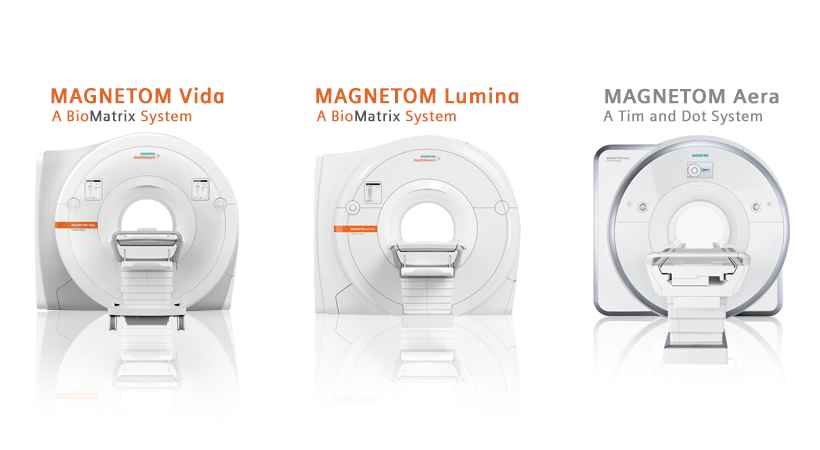
The MRI service of the “Erebouni” Medical Center is equipped with state-of-the-art, latest-generation scanners: Siemens Healthineers Magnetom Aera 1.5 Tesla, Magnetom Vida 3 Tesla, and Magnetom Lumina 3 Tesla.
These new-generation MRI systems allow comprehensive examinations to be performed within the shortest possible time. They feature powerful magnetic fields and high-resolution imaging, resulting in more precise and clearer diagnostic information.
The MRI scanners ensure exceptional image quality and high-speed performance.
Joint prostheses or other orthopedic devices may be considered contraindications for MRI. However, as a rule, they are made of MRI-compatible metals and therefore, in most cases, do not prevent patients from undergoing the examination.
If you have joint prostheses or other orthopedic devices implanted, before undergoing an MRI examination you must provide the MRI service staff with the following documents:
An extract from your medical history (epicrisis);
The MRI report of the same or adjacent area performed after implantation;
The implantation certificate;
The device passport, including the manufacturer’s brand and model/series name;
Any document confirming MRI compatibility, if the prosthesis was implanted more than 20 years ago.
Stents, cava filters, and vascular shunts implanted in the human body are not contraindications for MRI examinations.
In most cases, the presence of a cardiac pacemaker does not allow MRI examinations to be performed. However, there are certain pacemaker models that can be temporarily switched off or set to a special mode during the MRI. This issue must be discussed exclusively with an arrhythmologist.
Unlike removable hearing aids, inner ear prostheses are often incompatible with MRI. The devices may be damaged, and examinations above the knee level are not permitted.
Postoperative clips, sutures, and metal wires after sternotomy are MRI-compatible and are not contraindications for the examination.
Pregnant women may undergo MRI examinations.
From the second trimester of pregnancy, MRI can be performed without restrictions.
To undergo an MRI under the Universal Health Insurance program or other insurance programs, reimbursement must be coordinated in advance with the relevant services. Otherwise, the examination can only be performed on a paid basis.


