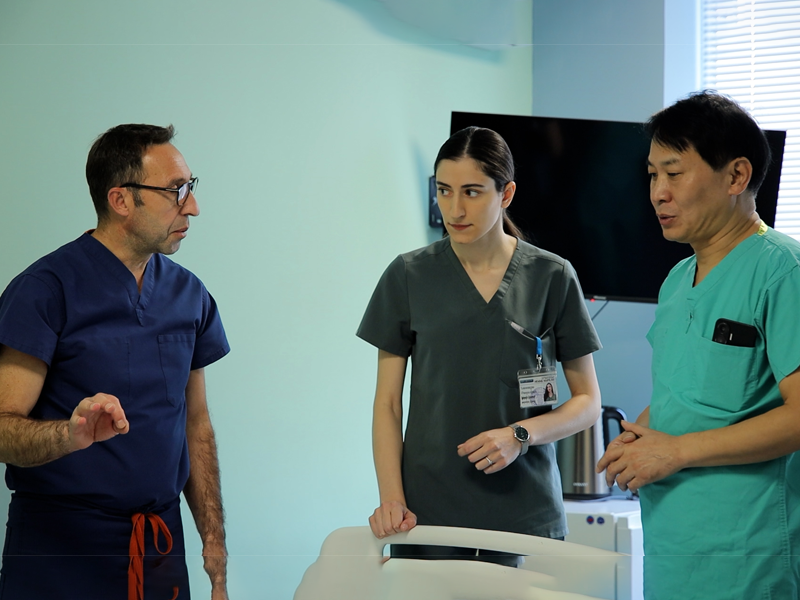
One of the most notable topics presented at a recently held international multidisciplinary oncology conference in Yerevan was “Surgical Treatment of Chest Wall Tumors.” Among the distinguished participants was Professor Wenlin Wang, a renowned surgeon from China, Director of the Institute of Chest Wall Surgery and President of the International Organization of Chest Wall Surgery. Professor Wang is globally recognized for his proprietary surgical method for correcting chest wall deformities. To date, Professor Wenlin Wang has successfully performed more than 10,000 surgeries using this technique.
During his visit to Yerevan, Professor Wang was hosted at Erebuni Medical Center, where he discussed with Armenian specialists the surgical management of chest wall tumors, as well as the correction of congenital and post-surgical chest wall deformities, addressing procedural techniques, specific features, and current challenges in the field.
Natalya Baghumyan, a thoracic surgeon at the Thoracic Surgery Department of Erebuni Medical Center, returned from China several months ago, where she enhanced her surgical knowledge and skills at the Second People’s Hospital of Guangdong Province and became closely familiar with the specifics of Professor Wang’s method. Notably, during a single day at that center, Dr. Baghumyan observed 83 surgical procedures.
Today, Professor Wenlin Wang is present in the operating theater of Erebuni Medical Center. Together with Armen Khanoian and other surgeons of the Thoracic Surgery Department, he is preparing to operate on a 20-year-old patient with a congenital chest wall deformity. In accordance with JCI (Joint Commission International) accreditation requirements, the final TIME-OUT safety check is performed immediately prior to surgery.
The patient’s chest wall deformity—characterized by inward displacement of the sternum and ribs—is known as pectus excavatum, also commonly referred to as “funnel chest.” This congenital defect is being corrected using Professor Wenlin Wang’s well-known surgical technique.
Through small incisions and specialized instruments, metal bars are placed beneath the deformed sternum. By rotating these bars, the depressed portion of the sternum is elevated, corrected, and securely fixed in position.
Professor Wenlin Wang’s refined surgical methods for correcting chest wall deformities have significantly reduced operative time and minimized postoperative complications.
Statistics indicate that if chest wall deformities, whether congenital or acquired, are left uncorrected, patients may develop cardiac and pulmonary complications over time, ultimately leading to a decline in overall quality of life.